






Explore robotic workstation safeguards, including physical guarding, presence detection, maintenance access and emergency stops, with key considerations for risk assessment.
Industrial robots perform repetitive, precise tasks and can reduce human exposure to hazardous processes. Their expanding use makes application-specific risk assessment and effective safeguarding essential. A safe workstation depends on the complete installation—not simply the robot or the presence of a protective fence.
This article outlines examples of protective measures and the questions to address when designing, selecting or upgrading a robotic workstation.
Industrial robot applications and their safety implications
Robots support production by carrying out monotonous operations that require precision and repeatability. They can also undertake tasks near hazardous processes where human exposure must be restricted for occupational safety reasons.
Foundry work is one example. Casting processes can involve temperatures of several hundred degrees Celsius, but this must not be confused with a robot’s permitted ambient operating temperature. Suitability for heat exposure depends on the equipment specification and the protective arrangements.
Two important application types are:
- Segregated robot cells: physical safeguards separate people from hazardous robot movements during operation. Separation does not eliminate every risk, particularly during access, maintenance or material transfer.
- Collaborative applications: people and robots work together under defined conditions. Safety depends on the complete application, including tooling, workpieces, movements and possible contact—not merely on the robot being described as collaborative.
Both arrangements require assessment of hazards to operators and anyone nearby. The robot’s installation, programming, tooling and intended human access all influence the necessary protective measures.
Machinery legislation and robot safety standards
Legislation establishes legal obligations, while relevant standards provide methods for addressing machinery risks. Standards are not simply “contained in” the EU Machinery Directive, and their publication date alone does not establish their applicability or harmonised status.
For EU projects, the applicable framework must be checked against the equipment’s placing-on-the-market date and other relevant circumstances. The transition from Machinery Directive 2006/42/EC to Machinery Regulation (EU) 2023/1230, generally applicable from 20 January 2027, is particularly important when planning new installations or upgrades.
Standards referenced in the original article
The original article cited the following Polish national designations and English titles. These are retained as historical references, not as confirmation of the current editions or applicable harmonised standards:
- PN-EN ISO 12100:2012 — “Safety of machinery. General principles for design. Risk assessment and risk reduction”.
- PN-EN ISO 10218-1:2011E — “Robots for industrial environments. Safety requirements. Part 1: Robots”.
- PN-EN ISO 10218-2:2011E — “Robots for industrial environments. Safety requirements. Part 2: Robot systems and system integration”.
- PN-EN 62061:2008 — “Safety of machinery. Functional safety of safety-related electrical, electronic and programmable electronic control systems”.
- PN-EN 13849-1:2008 — “Safety of machinery. Safety-related parts of control systems”.
Before using these references for design or conformity assessment, confirm the current editions, correct national designations, titles and relevant harmonised status. Selecting standards is only part of the process: the workstation still needs an application-specific risk assessment and verification of the resulting protective measures.
Examples of robotic workstation protective measures
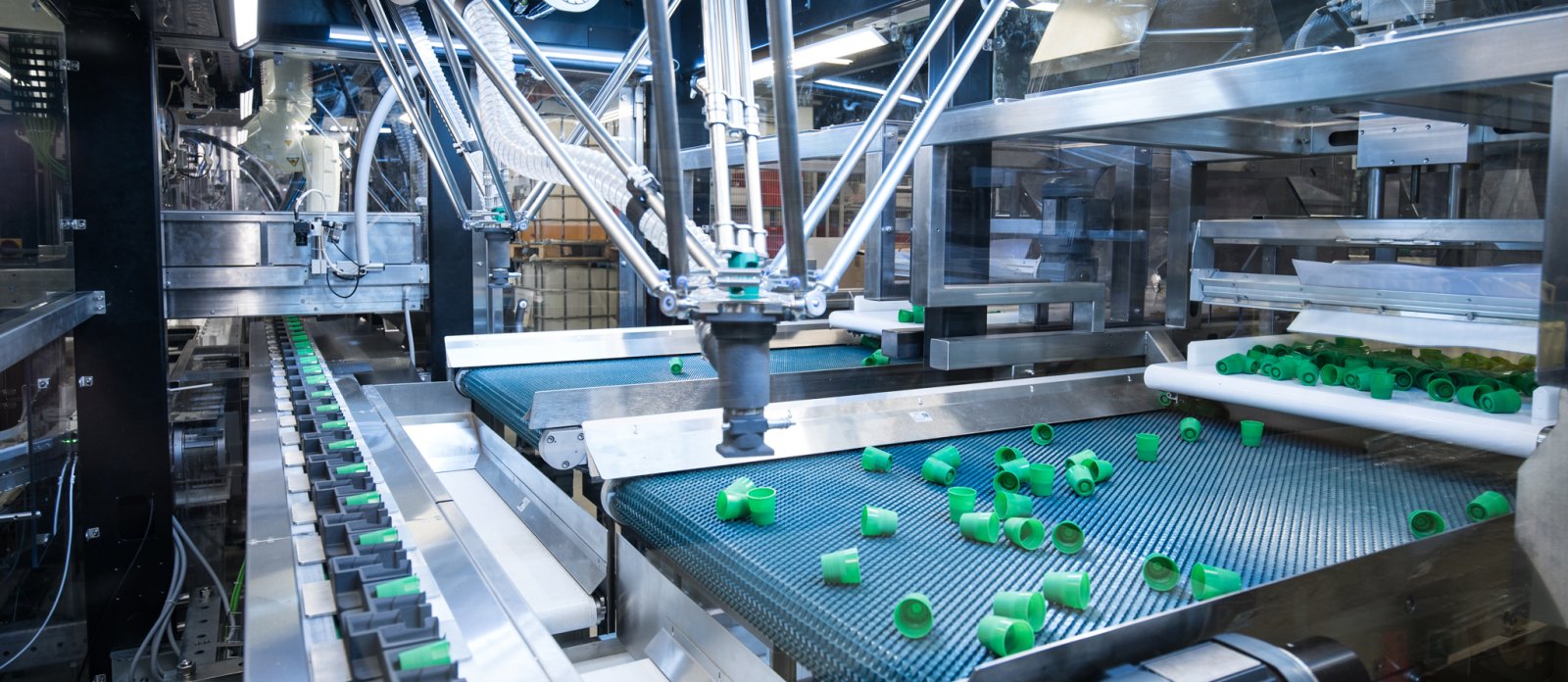
Physical guarding and conveyor openings
A protective enclosure can restrict access to a robot’s hazardous operating area. However, openings for conveyors or finished components may allow a person to reach through or enter the cell.
These interfaces need specific assessment. Suitable measures may include guarding arrangements and presence-sensing devices, depending on the opening, access possibilities and stopping performance. A light curtain does not stop hazardous motion instantaneously: its positioning must account for the complete safety system’s response and the machine’s stopping time. Any muting arrangement must also be assessed and validated for its intended use.
Presence detection inside and around the cell
Light curtains, pressure-sensitive floor mats and safety scanners are examples of devices that may detect access or occupancy in defined areas. Selection depends on the hazard and the required safety function.
Ordinary motion sensors are not interchangeable with safety-rated protective devices. Detection coverage and the response to a person remaining inside the cell must be considered as part of the overall safeguarding design.
Maintenance access and interlocked doors
Workstations need planned access for servicing and other necessary interventions. Where access doors form part of the safeguarding system, their interlocking arrangements must be selected according to the risk assessment.
Guard locking may be necessary where a person could reach a hazard before it has ceased. Electromagnetic locks are not a universal requirement or a complete safety solution. The assessment should also address escape arrangements, people remaining inside the enclosure and prevention of unexpected restart.
Access keys or button sequences may help manage authorisation, but they do not replace safety-rated interlocks, appropriate training or hazardous-energy isolation during servicing.
Emergency stops and warning signals
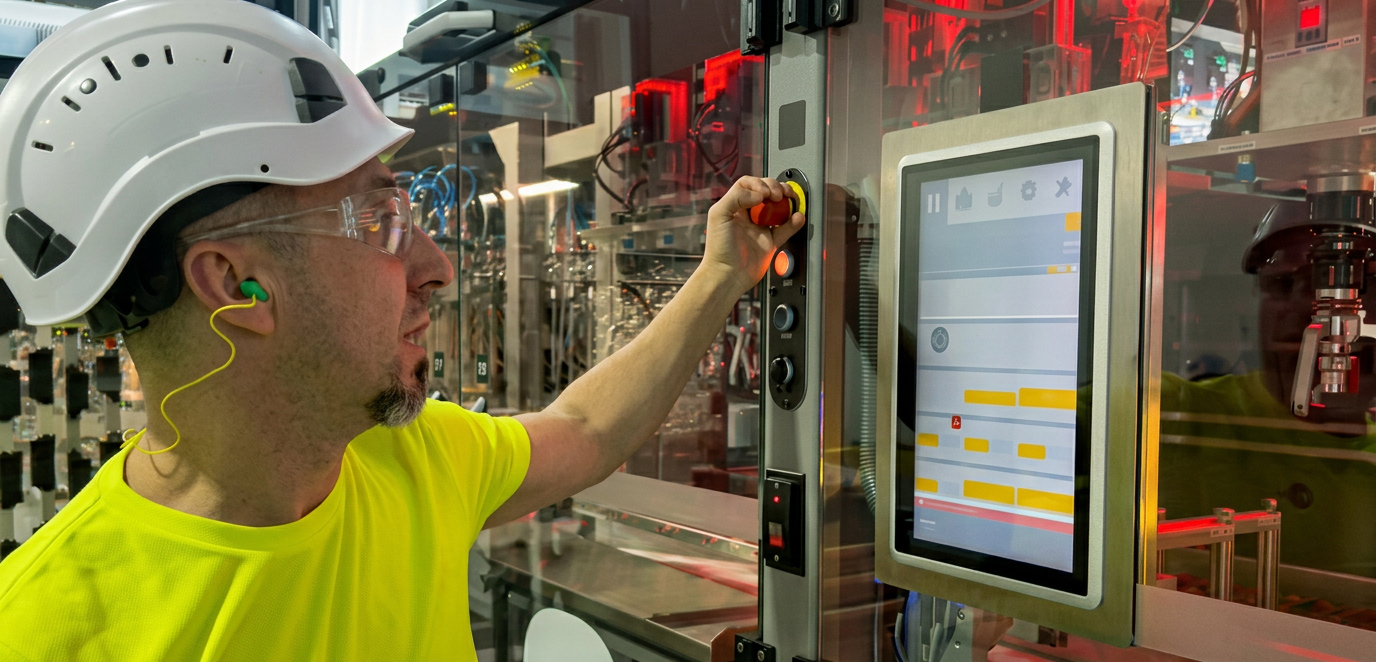
Emergency-stop devices must be accessible at positions determined by the workstation’s risk assessment, including inside the cell where appropriate. They provide a complementary protective measure; they do not replace guarding or, on their own, prevent unexpected start-up.
Audible alarms, signal lights and signal towers can communicate operating conditions or warnings. They supplement the safety arrangements rather than substitute for protective measures. Servicing procedures must address hazardous-energy isolation and safe restoration of operation.
From protective measures to a validated workstation
Robot speed, tooling mass, workpiece characteristics and human access can all affect the consequences of a hazardous event. Effective protection therefore requires coordinated measures rather than a universal checklist of ten rules.
The risk assessment should guide safeguarding selection, safety-related control functions and operating procedures. The resulting installation must then be checked and its safety functions validated for the intended application.
Safety questions for industrial automation integration
When planning industrial automation integration, ask how the proposed workstation will handle material transfer, operator access, maintenance and restart after an interruption. For a robotic packaging automation application, assess conveyor openings and interfaces with adjacent equipment alongside the robot cell itself.
Before selecting or upgrading equipment, ask who will assess the complete installation and validate its safety functions, including any changes to existing safeguards. To discuss a proposed robotic workstation purchase or upgrade, contact UNILOGO through the supplied contact form and confirm the relevant project scope.