





Robotics can support food packaging, palletising, cutting and cake decorating. Explore application choices, hygiene considerations, investment barriers and practical limitations.
Industrial and collaborative robots are used in food production for tasks ranging from packaging and palletising to cutting and cake decorating. Robotic packaging automation can reduce repetitive manual handling, but selecting a suitable system requires careful assessment of the product, operating environment, hygiene requirements and investment.
Successful implementation depends on matching the robot and its tooling to a clearly defined task—not simply replacing a manual workstation with a robot.
Table of contents:
- Robotics in the food manufacturing sector
- Food handling, packaging and palletising
- Examples: robotic cutting and cake decorating
- Benefits, limitations and application assessment
Robotics in the food manufacturing sector
Food manufacturing includes both large production plants and small or medium-sized businesses. The cost and perceived risk of automation can be significant barriers for smaller manufacturers, making application economics an important part of any investment decision.
The original article cites an approximately 13% European Union share of the food-industry market and around four million food-manufacturing jobs. These figures lack a stated date, geographical scope for employment and supporting references, so they should not be treated as verified current statistics.
The source also describes adoption as concentrated in multinational businesses, with smaller companies beginning to introduce robotics. Without supporting market data, this should be understood as the source's assessment rather than an established measure of current adoption.
Robotics is not an inevitable investment for every manufacturer. Its suitability depends on the task, operating requirements and expected value. Industrial and collaborative robots may both be considered, but neither designation alone establishes suitability for a particular food-production application.
Food handling, packaging and palletising
Applications discussed in the source include picking, pre-packing, packaging and palletising finished products. A key distinction is whether the equipment handles packaged goods or may contact exposed food.
Palletising packaged products
Palletising involves arranging finished packs or cases onto pallets. Serial-chain robots can perform this work, but robot architecture should be selected according to the required payload, reach, movement and operating speed rather than a general rule.
Handling packaged products differs from direct food handling. However, packaging does not automatically remove hygiene obligations: the installation environment and application risk assessment still determine the relevant cleaning and protection requirements.
Picking and packing exposed food
Picking and packing individual food items can require different payloads, movements and handling methods from palletising. Robotic packaging handling must account for the product and the task, rather than assuming that all picking applications need a smaller or faster robot.
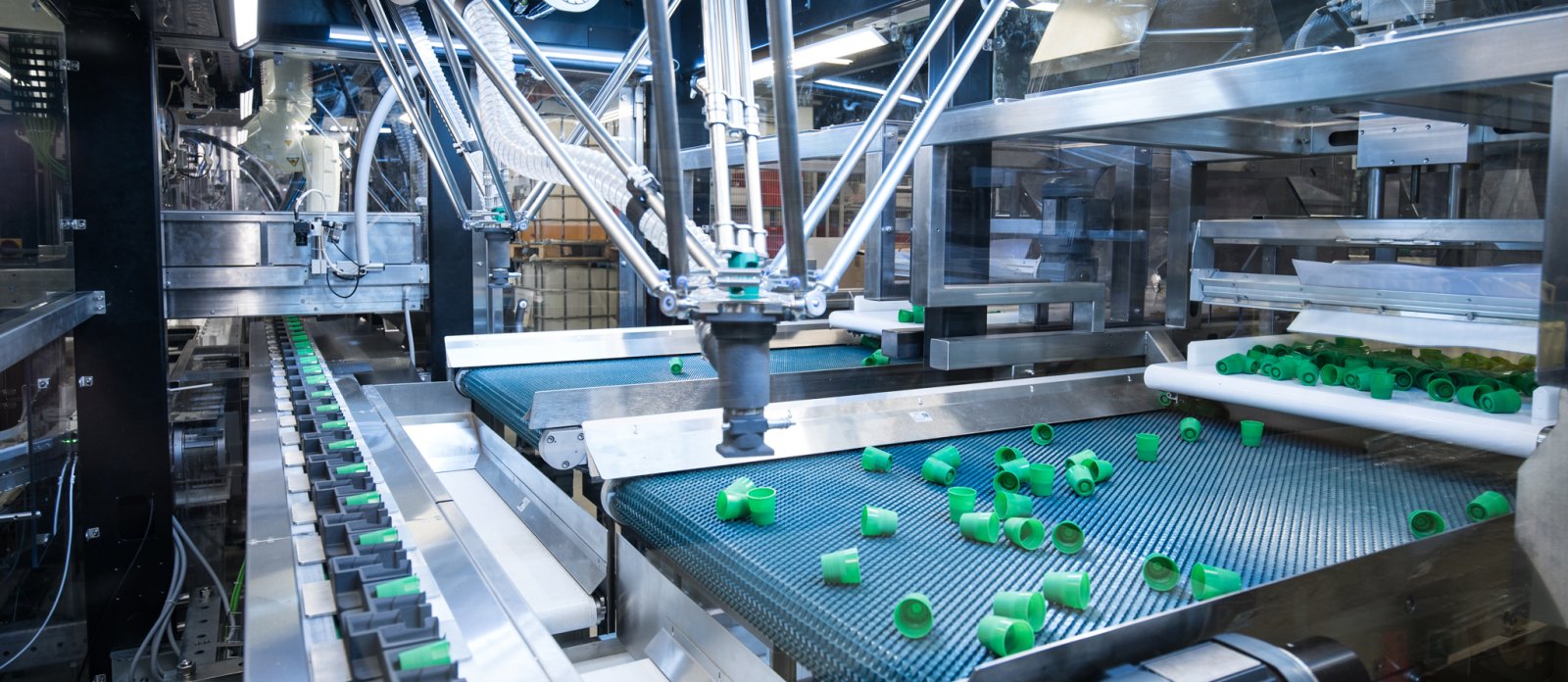
SCARA, parallel architectures such as delta robots, and articulated serial-chain robots are distinct options. SCARA robots should not be described as parallel-chain robots. Their suitability depends on the required motion, payload, speed and application conditions.
Hygiene, cleanability and ingress protection
Where equipment may contact unpackaged food, hygienic design, cleanability and food-contact requirements need application-specific assessment. Protective coatings can contribute to a design, but a coating alone does not establish compliance with all relevant hygiene requirements.
The original article describes food-industry robots as usually IP67-rated, but provides no evidence for that generalisation. IP67 concerns protection against dust and specified water-ingress conditions; it does not establish food-contact suitability, guarantee lubricant containment or demonstrate compatibility with every cleaning process.
Robot selection should therefore consider the complete installation, including tooling, exposed surfaces and the intended cleaning method—not an ingress-protection rating in isolation.
Examples: robotic cutting and cake decorating
Vision-guided cutting of irregular carcasses
Animal carcasses have irregular shapes, making cutting more complex than repeating a fixed path on identical parts. The source describes vision guided robotics in which software uses camera images to model a carcass and determine cutting locations.
In the described workflow, a robot either carries a cutting tool or uses a gripper to guide the carcass towards a saw. This illustrates how image-based information can inform robotic movement, but the source does not identify a documented installation or establish its accuracy, throughput or operating limits.
Robotic cake decorating and visual inspection
Cake decorating combines repetitive movements with the need for consistent positioning and patterns. Regularly shaped, mass-produced cakes and baked goods can provide a more predictable basis for programming these movements.
The source describes robots fitted with attachments selected for the topping, cream or decoration being applied. It also describes vision-based guidance and machine vision inspection of the finished decoration. Such automated quality inspection requires defined acceptance criteria; the source does not specify which defects are detected or how inspection performance is validated.
Software-based changes can allow decoration patterns to be modified when a product design changes. The practical scope of those changes still depends on the installed tooling and application.
Benefits, limitations and application assessment
Robots can perform repetitive movements consistently and reduce the amount of repetitive lifting assigned to operators. These benefits should not be expressed as unlimited precision or uninterrupted operation: robots remain subject to payload limits, wear, maintenance and operating constraints.
When evaluating production automation solutions, manufacturers should define:
- The task, product variations and whether exposed food will be handled.
- The required payload, reach, speed and handling method.
- The installation's hygiene, cleaning and food-contact requirements.
- Any vision-guidance or inspection functions and their acceptance criteria.
- The investment case and practical operating limitations.
For advice on whether a robotic application could fit your process, use the contact form to discuss your requirements with the consulting team.