





From fragrance formulation to bottle closing, perfume production requires coordinated processes, suitable machinery and a clear understanding of what to manufacture or outsource.
For manufacturers planning a new fragrance, machinery selection starts with defining the production scope: ingredient preparation, blending, bottling or a combination of these operations.
- Stages of perfume production
- Perfume production machinery
- Contract perfume manufacturing
- Planning equipment requirements
What are the stages of perfume production?
The perfume manufacturing process begins with fragrance development and production planning. Customer preferences and products already available on the market inform the concept. Research and trials then establish the ingredients and their proportions.
Production preparation includes sourcing raw materials and packaging components, selecting machinery, designing the process, and organising logistics and distribution.
Fragrance ingredients and extraction
Perfume ingredients can be natural or synthetic. Natural fragrance materials may come from plant or animal sources, while synthetic ingredients are manufactured chemical compounds. Synthetic materials can reproduce fragrance characteristics associated with flowers, fruit and trees.
Ingredient choice affects cost and fragrance characteristics. Synthetic materials can offer cost or stability advantages, although these depend on the individual ingredient and formulation. Examples include aldehydes used in fragrance compositions and vanillin, which provides a vanilla scent.
Where natural fragrance materials are extracted, the method depends on the raw material. In steam distillation, steam passes through plant material, carrying volatile fragrance components that are subsequently condensed and separated. Other extraction techniques include solvent extraction and enfleurage. Not every perfume manufacturer performs extraction in-house.
Blending, testing and packaging
Fragrance formulation requires trials to establish the intended scent and ingredient proportions. During production, ingredients are blended according to the developed formula. Essential oils, alcohol and distilled water are among the ingredients described in the source process.
Testing and measurement support process control. Once the product is ready, it is filled into bottles, fitted with the appropriate closures and packed into individual and bulk packaging.
Which perfume production machinery is needed?
Equipment requirements depend on which stages a manufacturer carries out. Raw-material extraction, blending and perfume bottling serve different purposes and should not be treated as interchangeable operations.
- Extraction equipment: distillation equipment is used where fragrance oils are obtained from natural raw materials.
- Mixing equipment: mixers combine formulation ingredients to obtain the intended product properties.
- Liquid filling equipment: a bottle filling machine dispenses the finished perfume into individual containers.
- Closing equipment: the closing operation must accommodate the specified atomiser, micro-spray or other closure.
- Measuring instruments: scales and instruments for temperature, pH and density measurement support control of the manufacturing process.
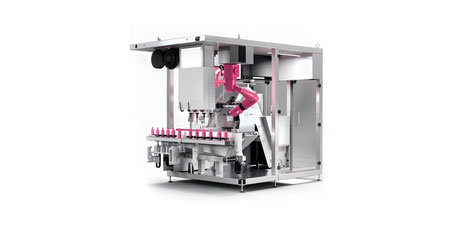
The source identifies Unilogo's Perfumline 50 as a filling and closing machine for perfume applications. It describes this type of equipment as working with commonly used perfumery closures, including atomisers and micro-sprays, and providing precise dispensing. No numerical filling accuracy or production capacity is supplied.
When specifying a perfume filling line, define the bottle, closure and dispensing requirements before selecting equipment. The supplied information does not establish compatibility with every container or closure format.
What does contract perfume manufacturing involve?
Contract perfume manufacturing allows a brand to outsource fragrance development or production rather than perform every operation internally. This can also serve companies outside the perfume industry that want their own fragrance range.
Perfumes may form part of a customer-facing product range or be used as gifts for employees and clients. The contractor's scope varies: one supplier may develop only the formula, while another may undertake additional production stages. Responsibilities therefore need to be defined for each project.
Planning equipment around the production scope
Perfume production combines formulation, ingredient sourcing, blending, testing and packaging. The practical starting point is to decide which stages will remain in-house and which will be outsourced.
Unilogo builds perfume production machinery for the cosmetics industry. To discuss equipment requirements and suitable options, contact the team through the contact form.