





Understand the key considerations for handling and storing flammable materials, assessing machinery hazards and planning substance-specific safety measures.
Manufacturing with flammable materials requires careful control of storage conditions, ignition sources and equipment hazards. The appropriate precautions depend on the substance, its physical state, the process and the regulations that apply at the site.
This overview outlines the main considerations for industrial workplaces. It does not replace a substance-specific risk assessment, safety data sheet or competent fire and explosion safety advice.
What are flammable materials?
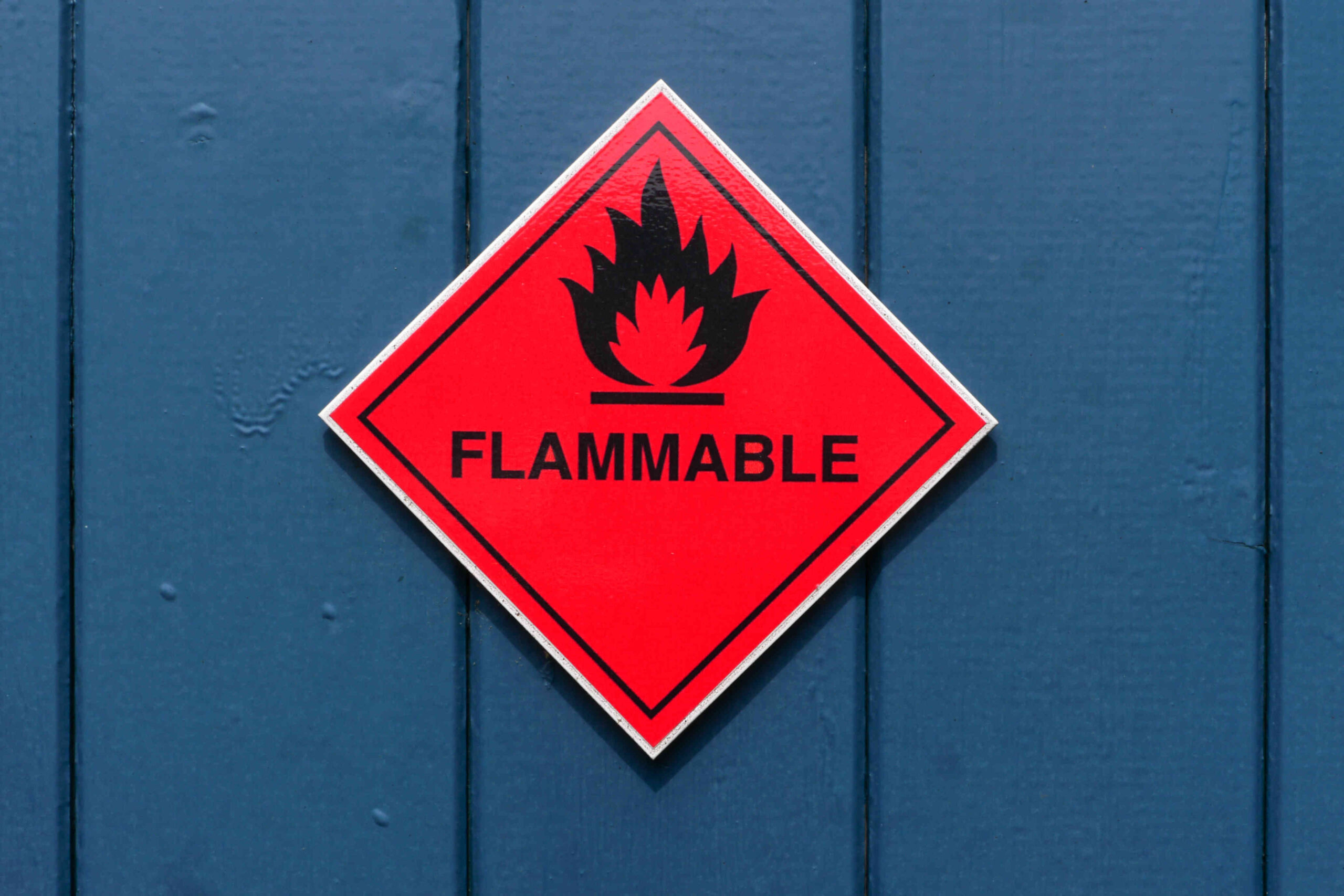
Flammable substances can ignite under suitable conditions when exposed to an ignition source, such as a spark or sufficient heat. They are used in construction, transport, the manufacture of everyday products and many other industrial processes.
Materials encountered in these settings include petrol, ethanol, propane and butane, diesel, motor oil, aromatic hydrocarbons, paper, plastics and textiles. Aerosol products may also present fire hazards. These materials do not share one hazard classification or one set of storage requirements.
Physical state and flash point
Whether a material is a liquid, gas or solid affects how its hazards must be assessed. Aerosols and liquefied gases require consideration of their particular properties and packaging; they cannot simply be grouped with liquids using a flash-point scale.
For liquids, flash point is an important assessment parameter. It concerns the temperature at which a liquid gives off enough vapour to ignite under specified test conditions; it is not the same as auto-ignition temperature. Thresholds such as 55°C and 100°C are not a universal classification system, and materials should not be assigned to these bands without checking their safety data sheets and the applicable rules.
Materials may be naturally occurring or manufactured. Their composition, including solvents, dyes and other ingredients, can affect their hazards. Assess the actual formulation rather than relying on a broad product name.
Flammable materials: storage and use
Even small quantities can present a fire risk. Storage and handling arrangements should follow the substance supplier's instructions, the safety data sheet, the site's fire safety procedures and applicable local requirements.
Storage areas and workstation quantities
- Keep materials away from ignition sources, including sparks and inappropriate heat sources.
- Provide ventilation appropriate to the substances and the assessed risk.
- Separate incompatible substances and arrange storage to avoid hazardous interactions or unstable stacking.
- Limit workstation quantities to what the process needs, subject to the site's risk assessment and applicable legal limits.
- Use designated storage arrangements for reserve quantities where required.
A daily production allowance is not a universal legal limit. Likewise, restrictions on storage in basements, attics, lofts or publicly accessible areas depend on the substance, building and jurisdiction. Confirm permitted locations before establishing storage, and keep escape routes clear.
Protect containers from heat and follow substance-specific instructions concerning direct sunlight and storage temperature. Avoid assuming that the same conditions are suitable for every material.
Containers and static-charge control
Use containers or storage systems suitable for the substance and operating conditions. Check chemical compatibility, closure integrity and resistance to foreseeable mechanical damage. A description such as “flame-retardant” does not, by itself, establish container suitability.
Assess electrostatic ignition risks during handling and transfer. Where required by the assessment, provide appropriate static-charge control measures. Do not assume that every container material can safely dissipate charge or that a liquid's flash point alone determines all container requirements.
Machinery requirements for potentially explosive atmospheres
Machinery selection must address the actual fire and explosion hazards of the process. The presence of a flammable substance does not automatically mean that every machine requires the same protective measures.
Distinguish equipment requirements from workplace duties
In the European Union, Directive 2014/34/EU superseded Directive 94/9/EC and concerns equipment and protective systems intended for use in potentially explosive atmospheres. Directive 1999/92/EC addresses workplace protection for workers potentially at risk from explosive atmospheres. Their applicability and the relevant national implementation requirements must be checked for the installation.
A machine containing flammable substances may present internal explosion hazards even where its surroundings are not classified as a potentially explosive atmosphere. This requires assessment of the equipment, its intended use and the conditions inside and around it, rather than a blanket statement that all such machinery must comply with ATEX.
Fire detection, suppression or other protection measures should be determined through the applicable requirements and risk assessment. A dedicated fire protection system is not a universal requirement for every machine handling a flammable material.
Inspection and fault correction
Machinery must remain in an appropriate technical condition. Regular inspections and prompt correction of safety-related faults are important because defects can increase ignition or explosion risks. Inspection scope and frequency should follow the equipment documentation, operating conditions and applicable requirements.
Specifying custom packaging machinery for flammable substances
When specifying custom packaging machinery, give the supplier substance-specific safety data, process conditions and the results of the explosion-risk assessment. These inputs should guide discussions about equipment selection, protective measures and applicable compliance requirements, rather than assuming a standard configuration is suitable.
Include packaging machinery maintenance, inspection access and fault-response procedures in production planning. If considering UNILOGO as a potential supplier, use the contact form to discuss the application and request verification of relevant experience, equipment capabilities and compliance documentation before making a selection.